 Real Estate Camera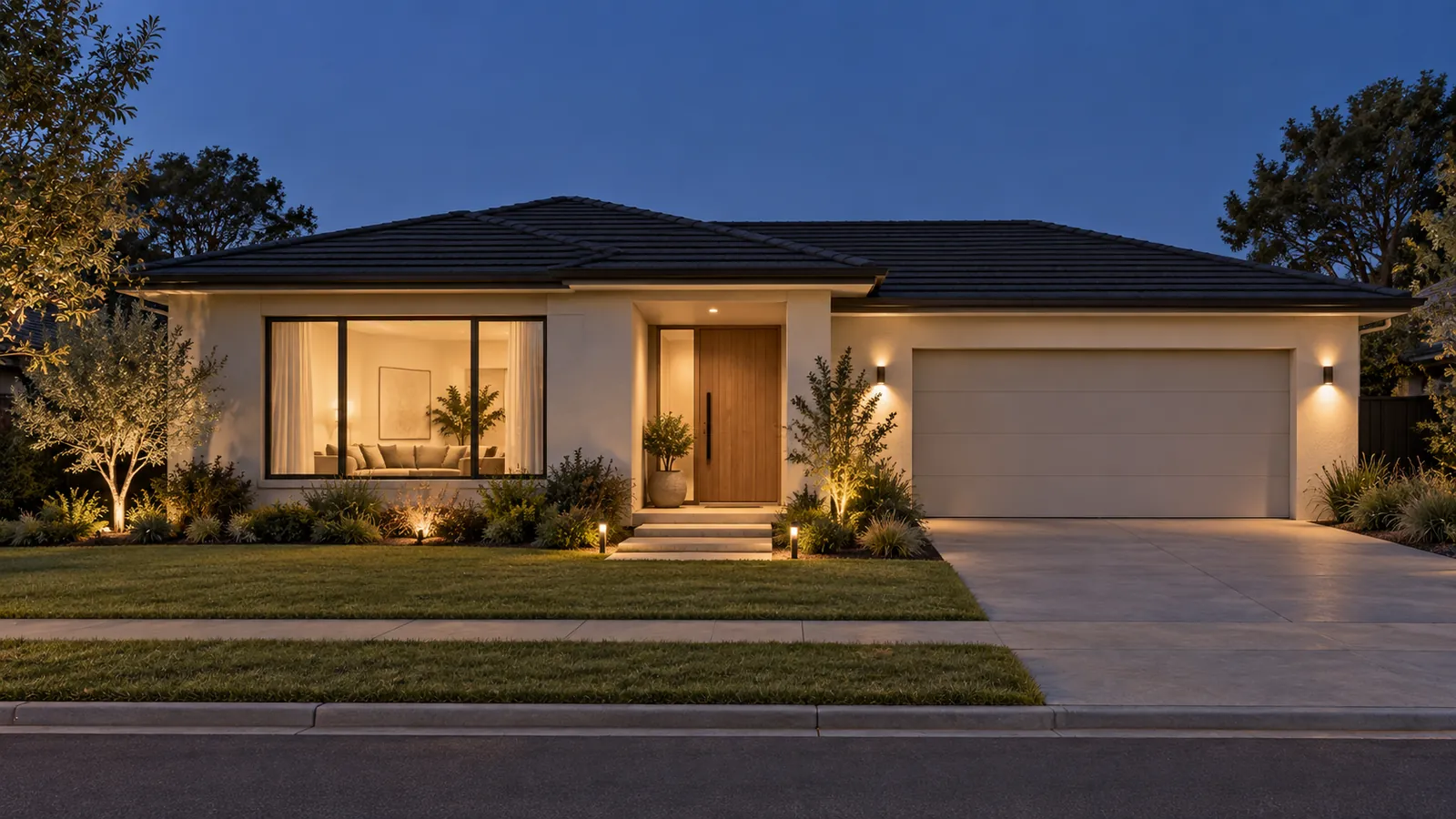
A twilight photo is worth taking for a house with good exterior lighting, attractive views, a swimming pool or architecture that looks striking at dusk. Use one as the main photo and keep the daytime set as well. As of September 2026, a professional twilight shoot costs about $295 to $350, and a virtual twilight edit costs $4 to $25 per photo. Label any virtual twilight images as edited. Some MLSs, including Stellar, prohibit twilight images that add lighting the property does not have or show the sunset in the wrong position.
The prices and rules below are taken from the pages linked alongside them. Real Estate Camera, our app, does not create twilight photos at all, and I explain why towards the end.
What is a twilight property photo?
A photograph of the exterior, taken just after sunset, with all the lights in the house switched on. Redfin describes this as the "golden hour" or "blue hour", when the sun is just below the horizon and the sky turns a deep blue. The warm glow of the windows against the blue sky is what makes the shot.
A virtual twilight image, also called day-to-dusk, is a daytime photo edited to look like that. The editor replaces the sky, darkens the scene and adds light to the windows and light fittings.
Real vs virtual twilight: costs and trade-offs
| Real twilight | Virtual twilight | Doing it yourself on a phone | |
|---|---|---|---|
| Cost (Sept 2026) | $295 add-on or $350 on its own, up to 10 photos (Estate Photos L.A.) | $4 per photo (BoxBrownie), $25 per photo (Estate Photos L.A.) | Your evening |
| Turnaround | 24 to 48 hours after the shoot | 24 hours at BoxBrownie | Same night |
| Accuracy | Shows the actual lights and sky | Lighting and the sky are digitally added | Real, if you get the timing right |
| Label required? | No | Yes, to be safe; required in some areas | No |
| Weak point | One shot at the right time; weather can rule it out | May show lighting that is not really there | Phone cameras struggle in low light |
Sources: Estate Photos L.A. prices and BoxBrownie's day-to-dusk page, as of September 2026. BoxBrownie's $4 price includes its sky replacement and lighting process; removing shadows costs an extra $8. Zillow Media Experts offers both: virtual twilight in its Premium package, and real twilight as an add-on with 10 to 15 HDR images.
Are twilight photos worth it?
I couldn't find a well-sourced study measuring the difference between twilight and daytime photos in terms of price or time on the market, so I won't quote a figure. Plenty of pages quote numbers without citing a source. Here's how I'd decide.
Worth it:
- A house with garden lighting, a lit pool or a warmly lit porch. A twilight shot shows something real that a daytime photo can't.
- A view that comes to light at night, such as a city skyline or an illuminated bridge, provided it really is visible from the house.
- A listing where the daytime exterior is weak because the house faces the wrong way and the sun is always behind it. See exterior photos for advice on timing.
- Higher-priced listings where an extra cover shot costs very little compared with the commission.
Not worth it:
- A house with just one porch light and dark windows. A twilight shot will look gloomy, or a virtual one will invent lights.
- A flat where the exterior isn't the main selling point.
- Any listing where the only way to make it glow is to add light fittings that aren't there.
How many? Redfin suggests 2 to 5 twilight photos, and says they complement daytime photos rather than replace them. For most houses, I'd shoot one of the front and maybe one of the garden, then use the best as the cover shot.
What MLS rules say about twilight photos
Twilight photos are usually allowed, subject to conditions. Stellar MLS Article 04.04 puts it most plainly:
Twilight photos are acceptable as long as lighting is not added where it does not exist and sunset/sunrise is a true reflection of where the sun rises and sets.
Two things fail that test, and both can easily happen by accident with a virtual twilight shot. The editor lights a flowerbed that has no light fitting, or places an orange sunset behind a house that faces east. Stellar also bans adding lighting or views "not within a property owner's control."
In California, AB 723 covers any image altered to add, remove or change elements, and it names things outside the property, such as street lights and views. A virtual twilight shot changes the sky and adds light. Our AB 723 guide treats that as an alteration: a note plus a link to the original daytime photo. I'd do the same everywhere. It takes just one line of caption, and nobody can later claim the photo misled them.
How to capture a genuine twilight shot on a phone
- Check which way the house faces. A west-facing front catches the sunset glow behind the camera. An east-facing front will be darker, with a bluer sky above it.
- Switch on all the lights an hour beforehand, inside and outside. Open the blinds in the front windows. Replace any dead bulbs, as a dark window gives the impression that it is missing.
- Set up before sunset. Frame the shot while there is still daylight: position the tripod at chest height, keep the phone level, use the 1x or 0.5x lens, and shoot from the same corner as your daytime cover shot.
- Shoot from sunset until about 20 minutes later. Take a shot every minute or two. The best is usually taken when the sky is still blue and the windows are only just brighter than the sky.
- Let Night mode work, and do not touch the phone. Apple says that Night mode switches on automatically in low light and recommends a tripod for greater detail. Use the timer so that tapping the shutter does not shake the phone.
- Pick one, straighten it, and stop there. Straighten the verticals and leave the sky as it is. See fixing vertical lines.
A twilight shot taken on a phone will not match a professional's bracketed, blended image. It will look authentic, and for a modest house that often appears more convincing than a retouched shot.
Why Real Estate Camera does not create twilight shots
Our app corrects lighting and colour, straightens verticals, declutters images and adds Virtual staging. It does not replace skies or create twilight shots, by design. A virtual twilight adds light and replaces the sky, which is exactly the sort of edit covered by rules such as Stellar's and California's. A buyer who arrives at 6 pm and finds just one porch light where the photo showed a glowing garden starts wondering what else was changed.
That means we cannot provide a dusk cover shot. If you want one, shoot at dusk, or send a single hero shot to a service such as BoxBrownie and label it. For the rest of the listing, Enhance costs 1 credit per photo; see pricing. For the whole exterior shoot, read how to photograph a house's exterior; for sky swaps specifically, see sky replacement in listing photos.
For details of what Enhance does and does not change, see AI real estate photo editing.
Retouch the daytime shots on your phone before the twilight shoot. Start free: 1 credit.
Questions
Are twilight property photos worth it?
For a house with good exterior lighting, attractive views, a swimming pool or striking architecture, one twilight photo for the listing is often worthwhile. For an ordinary house on a busy street, it adds little. Redfin recommends 2 to 5 twilight photos to complement the daytime set, rather than replace it.
What do twilight property photos cost?
As of September 2026, one Los Angeles studio lists a real twilight shoot at $295 as an add-on, or $350 on its own, for up to 10 photos. Virtual twilight edits cost $4 per photo at BoxBrownie and $25 per photo at the same studio.
Do virtual twilight photos need to be labelled?
Label them. Stellar MLS permits twilight photos only where no lighting has been added to an area that has none and the sunset matches the position of the real setting sun. California's AB 723 applies to images altered to change elements of the picture. The safest approach wherever you are is to label a virtual twilight image and publish the original daytime photo.
When is the best time to take twilight property photos?
In the brief period after sunset when the sky is still blue and the house lights are in balance with it. Start setting up before sunset and take photos for the next 20 minutes or so, because the light changes quickly.