 Real Estate Camera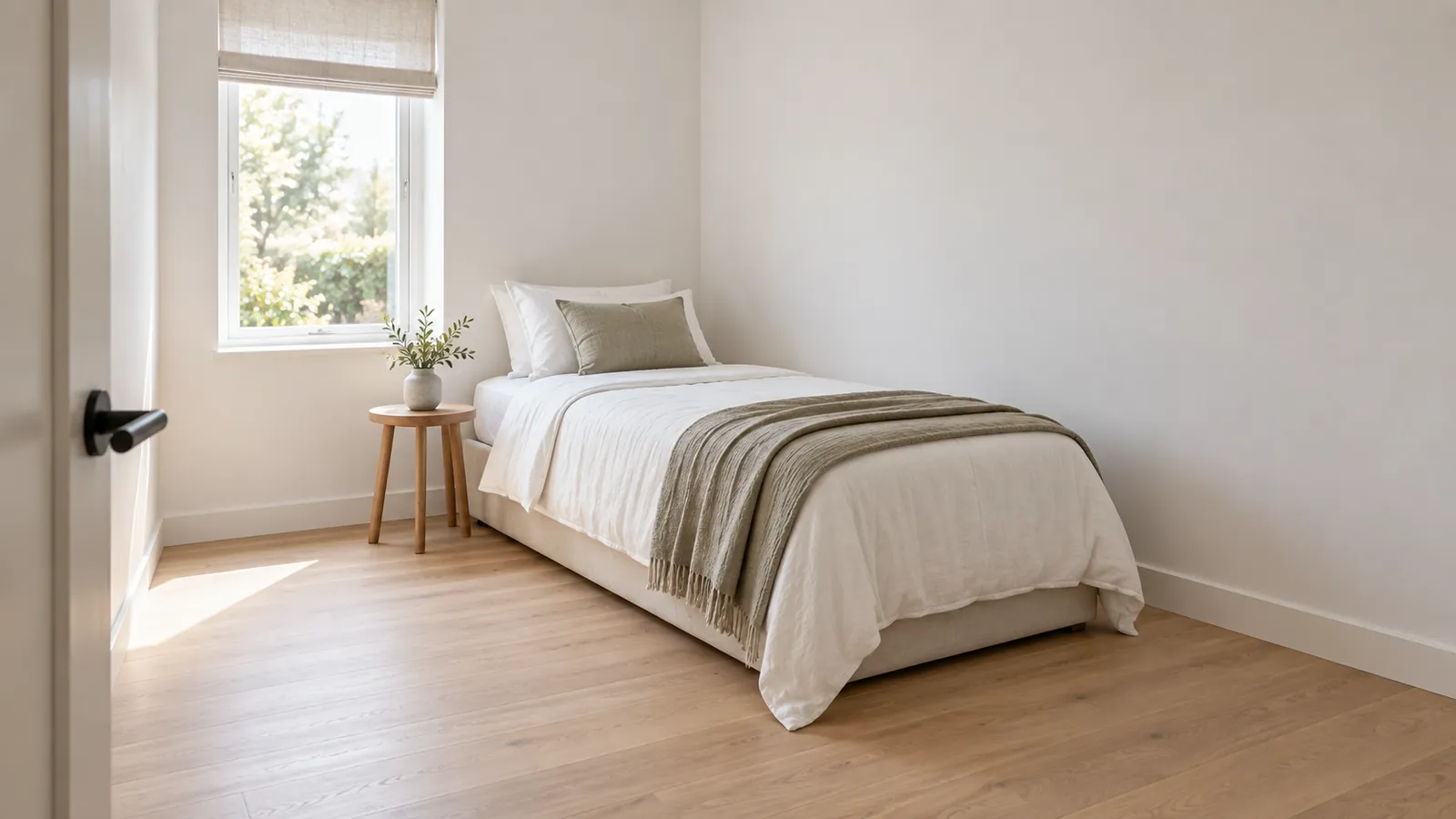
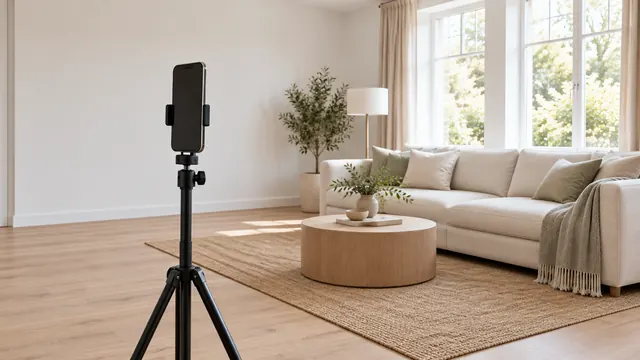
Stand in a corner or the doorway, hold the phone level at chest height, and frame two walls and the floor. Use the 0.5x lens only if 1x can't capture the whole room, and keep furniture away from the edges of the frame, where the ultra-wide lens distorts it. Clear the floor, open the blinds, turn on every light and leave the door to the next room open. Don't try to fake the room's size with tiny furniture or heavy stretching. Buyers will measure it at the viewing.
This applies to small bedrooms, home offices, nurseries, utility rooms and extra rooms. Bathrooms have their own guide: how to photograph a small bathroom.
Where should you stand to photograph a small room?
In the corner opposite the window, or just inside the doorway. From a corner, you can see two walls meeting, giving the room depth. Shooting straight at one flat wall makes a small room look like a box.
Try both positions:
- The far corner. Back yourself into it, with your feet against the skirting boards. This usually gives the widest view with the window in frame.
- The doorway. Step one foot inside. It gives buyers their first view of the room, and the doorframe doesn't hide anything of importance.
- Not the middle of the room. You'll be too close to every wall and still miss one.
Zillow's photography tips recommend shooting at chest height with the phone held sideways, leaving doors open between rooms to show the layout and avoiding large objects in the foreground. All three matter more in a small room. A chest of drawers at the front of the frame blocks half the floor, while an open door into the hall shows how the room relates to the rest of the house.
Should you use the 0.5x lens?
Often, but check it against 1x first. The ultra-wide lens captures more of a compact room in a single frame. It also stretches anything near the edges, so a bedside table in the corner of the frame becomes elongated and distorted, while the far wall looks further away than it really is.
| 1x (main lens) | 0.5x (ultra-wide) | |
|---|---|---|
| Suits the room? | Often not in a small bedroom | Usually, from a corner |
| Edge distortion | Very little | Distorts furniture and walls near the edges of the frame |
| Sense of space | True to life | The room looks larger than it really is |
| Best for | Doorway shots, close-ups and rooms with a single feature | Corner shots when 1x cannot capture the whole room |
Two iPhone settings can help. Lens Correction, which is enabled by default on supported models, adjusts Ultra Wide photos "for more natural-looking results." The grid and level (Settings, Camera, Grid and Level) also help you keep the phone straight. A tilted phone makes walls appear to lean, and a small room has walls on every side. Taking listing photos with an iPhone explains the rest of the camera setup.
Preparation: what to remove from a small room
A small room can look cluttered in a photo very quickly. Before taking your photos:
- Clear the floor. Washing baskets, shoes, bins and cables. Showing the floor helps viewers see the room as usable.
- Remove one item. The chair in the corner or the second bedside table. If it's in your way as you enter, it'll be in the way in the photo.
- Clear the surfaces. Leave just one or two items on the desk, chest of drawers and bedside tables.
- Open the blinds and curtains fully. The window is the biggest feature in a small room.
- Switch on all the lights, including any lights inside the cupboard if its door is open.
- Close the wardrobe unless it's a selling point. An open wardrobe full of clothes makes the room look smaller.
Zillow's seller guide also recommends depersonalising the room: keep family photos, magnets, toys and pet gear out of the frame. If the room is too full to clear in person, you can declutter the photo instead. See our guide to decluttering listing photos.
Light a small room evenly
A small room with one window is often bright on one side and dark on the other. Shoot at midday, with the window to the side of the camera rather than straight ahead, so you're not pointing the lens at the brightest thing in the room. If the window is still blown out to white, fixing dark photos and blown-out windows explains how to correct it.
Mixed lighting is the other common problem. A warm ceiling bulb plus cool daylight gives you orange corners and blue walls. Match the bulbs, or correct the white balance afterwards.
What not to do to make a small room look bigger
Every trick that makes a small room look bigger online costs you at the viewing, and some are banned outright.
- Undersized furniture when staging. Stellar MLS bans "placing small furniture to make a room appear larger than it actually is," along with any edit that distorts a room's dimensions.
- Extreme stretching. A very wide lens held low makes a room look far deeper than it is. Buyers notice at the door, and they start doubting every other photo.
- Removing walls or closets in editing. That counts as altering the property, which is prohibited by every set of rules I've read.
- Calling it something it isn't. A room without a wardrobe or window may not qualify as a bedroom in your area. Label it accurately as an office or a multipurpose room.
Staging a small, empty room
It's hard to judge a small, empty room. Buyers can't tell whether a queen-size bed will fit. Virtual staging with standard-size furniture answers that question, and this is where staging helps most. Label the image and post the original photo of the empty room too. Our guide to what's allowed explains the rules.
Real Estate Camera (our app) stages an empty room in one of eight styles for 2 credits, about $0.67 to $1.00 depending on the pack, and labels the result. Enhance, for 1 credit, fixes the lighting, white balance and leaning verticals. It won't make the room look bigger, and it shouldn't. For the whole house, use the room-by-room shot list.
To shoot and stage the room using a single app, see the real estate photography app.
Shoot the small bedroom, then stage it before you leave the property. Start for free: 1 credit.
Questions
How do you make a small room look bigger in listing photos?
Shoot from a corner or the doorway, holding the phone level at chest height, so you can see two walls and the floor. Clear the floor, open the blinds, turn on all the lights and leave the door open to the next room. Don't use tiny furniture or extreme stretching to fake the size; Stellar MLS prohibits staging that makes a room look larger than it really is.
Should I use the 0.5x lens for small rooms?
Usually yes, but take care. The ultra-wide lens captures a small room in a single frame, but it stretches anything near the edges and makes the room look deeper than it really is. Keep the phone level, position furniture away from the corners of the frame, and try 1x from the doorway too.
Should I photograph a small room at all?
Photograph every bedroom, even the smallest, as buyers count them. One clear shot is enough. For a small office or a downstairs toilet, one photo or none is fine.
Can I use Virtual staging in a small room?
Yes, with normal-sized furniture and a label. Staging a small bedroom with a bed shows buyers that the room can fit one. Using undersized furniture to make the room look bigger is specifically banned on Stellar MLS.